Natural history
The Salamander That Lives Nowhere Else
Plethodon nettingi is about four inches long and is found only in the high country of eastern West Virginia. It was discovered on the same knob where the Union army built its fort.
In 1935 two naturalists, M. Graham Netting and Leonard Llewellyn, found a small dark salamander on White Top, the Cheat Mountain knob that had held Cheat Summit Fort in 1861.12 N. Bayard Green described it formally in 1938 and named it Plethodon nettingi, for Netting.2 It is now called the Cheat Mountain salamander.
It and the West Virginia spring salamander are the only vertebrates whose ranges lie entirely within the state.2
What it looks like
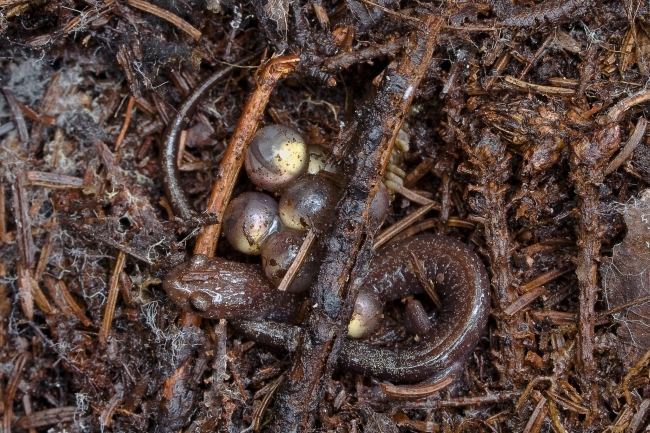
It is small, 3 to 4.75 inches long including the tail, about the size of the common red-backed salamander. Its back is black or dark brown with many small brassy, silver or white flecks, and it has no stripe. The belly is dark gray to black.2
Where it lives
Early surveys in the 1930s and 1940s found it only on Cheat Mountain above about 3,500 feet, in Randolph County and on Thorny Flat in Pocahontas County. Later surveys extended the known range into Pendleton, Tucker and Grant counties, where one population lives as low as 2,640 feet.2
The whole range covers about 935 square miles, but the salamander does not occupy it continuously. About 60 isolated populations are known, 46 of them in the Monongahela National Forest.2
It was probably a red spruce forest animal originally. It is now also found in mixed hardwood forests of yellow birch, beech, sugar maple and hemlock that replaced the spruce, and is often tied to boulder fields, rock outcrops and rhododendron ravines, where the ground stays moist and cool.2
What happened to it
Populations "probably plummeted" when the red spruce forests were logged in the early twentieth century.2 Most of those forests were gone by 1920. The logging is described in its own article on this site.
The salamander will not cross bare ground. That means even small clearings, such as service roads, hiking trails or ski trails, can split populations apart.2 Isolated populations lose genetic variety. Pollution, drought, storm damage and competition from the red-backed salamander add to the pressure.
Forest Service research published in 2022 found that a warming climate is shrinking the species' habitat. Cheat Mountain salamanders, in one headline's words, are "losing ground to climate."34
Legal status
The U.S. Fish and Wildlife Service listed the Cheat Mountain salamander as threatened under the Endangered Species Act in 1989. It remains listed.5
Older survey work by Thomas K. Pauley of Marshall University found numbers stable except where habitat had been altered.2 That assessment predates the climate research.
Seeing one
Most people never will. It is small, dark and lives under rocks and logs. Turning over rocks in its habitat disturbs the cool, damp cover it depends on. The Fish and Wildlife Service photographs on this page are the better way to see one.
The photographs
The photograph here is by Kent Mason of the U.S. Fish and Wildlife Service and shows a female guarding eggs. FWS marks it as public domain.6 We credit the photographer anyway.
Further reading
- Maurice Brooks, The Appalachians (1965), which tells the story of the discovery.2
- U.S. Fish and Wildlife Service species profile.5
Sources
- Wikipedia, "White Top" (Cheat Summit Fort) (CC BY-SA)
- Wikipedia, "Cheat Mountain salamander" (CC BY-SA)
- USDA Forest Service Northern Research Station, Rucker et al. 2022 (PDF)
- The Wildlife Society, "Cheat Mountain salamanders losing ground to climate"
- U.S. Fish and Wildlife Service, Cheat Mountain salamander species profile
- USFWS media, "Cheat Mountain salamanders guarding eggs" (Kent Mason/USFWS, public domain)
Published 2026-10-29. Corrections: see About.