Logging and railroads, 1899 to 1960
Spruce, Shays and the Company Town
For sixty years the mountain was a timber operation. A paper company built Cass, ran geared locomotives up grades that ordinary engines could not climb, and cut nearly every red spruce on the ridge.
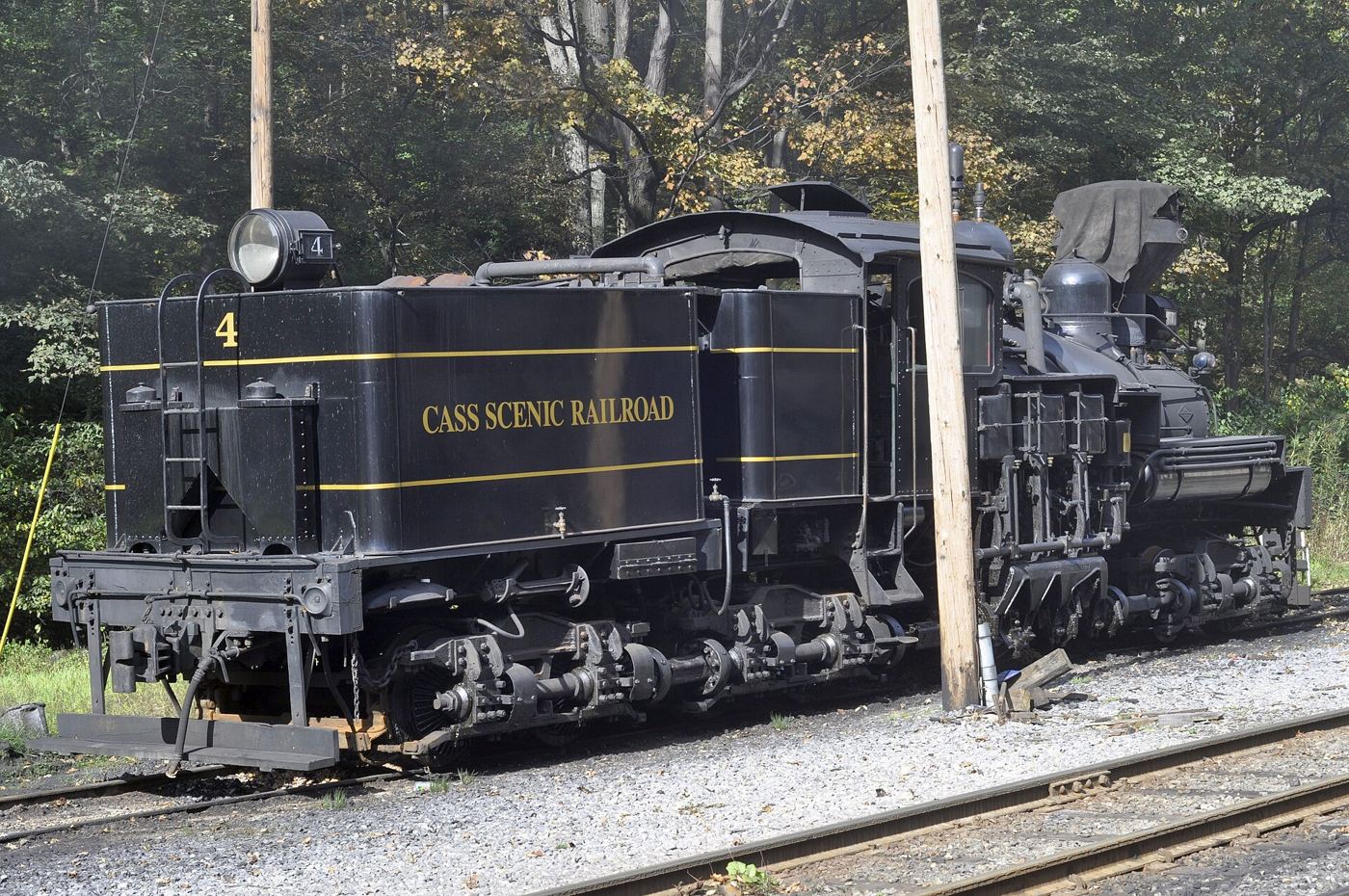
In 1861 the Union soldiers at Cheat Summit cut the first commercial timber on the mountain. They did it "with a small steam-powered circular sawmill."1 Forty years later, a paper company arrived and cut almost everything else.
Before the company
A lumberman named Dewing "introduced the first logging locomotive in this area, a small Shay engine." In 1899 he sold his holdings to the newly formed West Virginia Pulp and Paper Company.1 Little more is recorded about Dewing. Roy B. Clarkson's Tumult on the Mountains (1964), the standard history of West Virginia lumbering, is the likely place.2
Cass
West Virginia Pulp and Paper founded Cass in 1901 as a company town for the men cutting spruce and hemlock for its subsidiary, the West Virginia Spruce Lumber Company.3 The company is now part of WestRock.
The company's original interest was spruce for pulp. Only "several years later" did it realize the mountain also held a fortune in hardwoods, maple, cherry, birch and oak, and built a sawmill at Cass to handle them.3 The Cass mill became "the largest double-band sawmill in the world" and processed an estimated 1.25 billion board feet over its life.
Cass had a company store, company houses and company rules. The State of West Virginia now owns the town and its railroad as Cass Scenic Railroad State Park, which opened in 1960.45
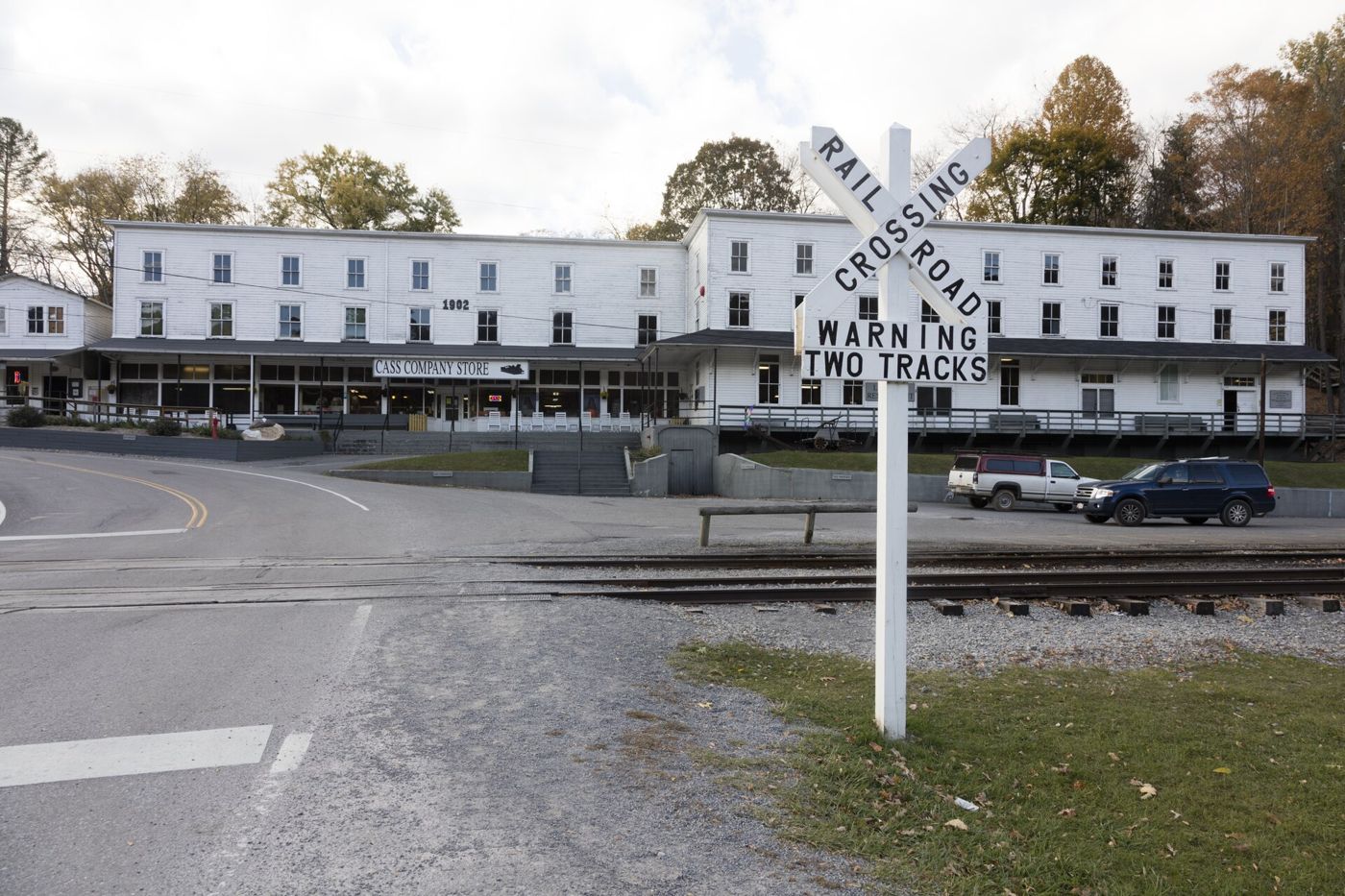
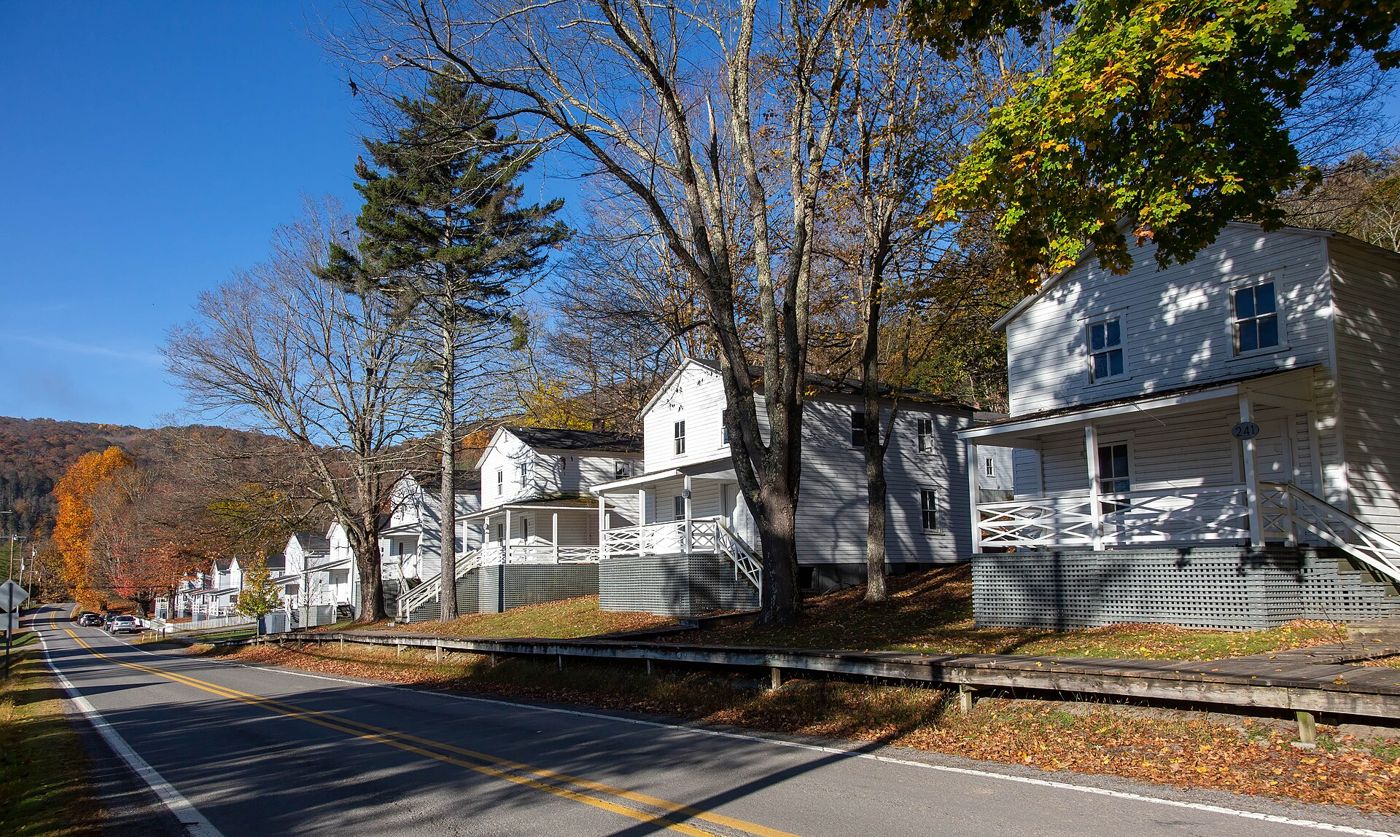

The company houses are still lived in, by visitors. The state park rents about twenty of the restored two-story houses as cottages year round, by the night for up to two weeks, sleeping from 2 to 14 guests.67 Book a Cass company house.

The railroad up the mountain
Work began in 1901 on a standard gauge line up Back Allegheny Mountain.3 It reached a meadow now called Whittaker Station, where a camp housed the immigrant workers building the line, then Gobblers Knob, then a spot on top of the mountain the company named Spruce. The railroad eventually reached the top of Bald Knob.
The grades were brutal. The resort puts them at "5 to 10%" on the line up from Cass, steep enough that "a special 40-ton Shay locomotive was developed to tackle" them.8 The state park's current excursions climb the same route.
Why a Shay
An ordinary steam locomotive drives its wheels with rods from cylinders on the side. On a steep, curving, badly laid logging track that design slips and derails. Ephraim Shay, a Michigan logger, worked out a different arrangement in the late 1870s: an engine on a flatcar with a boiler, gears, and trucks that could pivot. Lima Locomotive Works of Lima, Ohio built his prototype in 1880, and Shay received a patent for the basic idea in 1881.9 Shays "could operate successfully on steep or poor quality track," which is the whole of the logging railroad problem in one phrase.
The resort named a trail for them. Shay's Revenge and Heisler Way honor "brands of gear-driven steam locomotives that ferried men and logs around the mountains."10 The Heisler was a competing geared design. Another slope, Stemwinder, means "a Shay or other geared railroad locomotive."8
Spruce, the town
The camp at the top of the line became a town. The first settlement at Spruce dates to 1902, along Shavers Fork. In 1904 West Virginia Pulp and Paper built a pulp mill there, the new settlement beside it took the name Spruce, and the first one became "Old Spruce." The Greenbrier and Elk Railroad served it.11
The pulp mill closed in 1925. Its equipment went to the company's paper mill at Luke, Maryland, and Spruce emptied out. Little of it remains. The railroad that once served it now brings tourists to see the site.11
How long, how much
West Virginia Pulp and Paper logged the land that became Snowshoe from 1901 to 1960.12 Cutting on the mountain itself began about 1905, when loggers reached the summit, and "by 1960 the mountain was virtually barren."4 The heaviest cutting came in 1901 to 1910 and again in 1945 to 1950.8 On Bald Knob, the last harvest of red spruce and hemlock came in 1960, and the Mower Lumber Company was one of the last operators.13
Who did the work
W. E. Blackhurst's Of Men and a Mighty Mountain (1965) is the book most often cited about life in the camps, and it is unsparing about how hard the mountain was "for the mostly immigrant workers of the lumber operation."4
The Snowshoe slope names preserve the job titles. A ballhooter rolled logs downhill to a skid road. A knot bumper trimmed limbs with an ax. A gandy dancer laid and maintained track. A powder monkey handled the dynamite.8 There is a separate article on the names.
What the cutting did
The ecological cost was the red spruce forest, once "the largest red spruce forest south of Maine."4 By 1940 Bald Knob had been stripped of nearly all its virgin spruce.13 Most of the high-elevation spruce was cut down by 1920, some of the cut-over land was burned, and the Cheat Mountain salamander's numbers "probably plummeted" as a result.14
Spruce is coming back. The recovery is measured in generations.
Further reading
- Roy B. Clarkson, Tumult on the Mountains: Lumbering in West Virginia, 1770 to 1920 (McClain, 1964).
- Roy B. Clarkson, On Beyond Leatherbark: The Cass Saga (McClain, 1990).
- George H. Deike III, Logging South Cheat: The History of the Snowshoe Lands (1993).
- W. E. Blackhurst, Of Men and a Mighty Mountain (1965).
Sources
- e-WV: The West Virginia Encyclopedia, "Cheat Mountain"
- e-WV, "Tumult on the Mountains" (Roy B. Clarkson)
- Wikipedia, "Cass Scenic Railroad State Park" (CC BY-SA)
- Wikipedia, "Cheat Mountain" (CC BY-SA)
- West Virginia State Parks, Cass Scenic Railroad State Park
- West Virginia State Parks, "Top 3 Unique Places to Stay at West Virginia State Parks" (Cass company houses)
- Cass Scenic Railroad State Park, Lodging
- Snowshoe Blog, "Snowshoe Slope Name Origins" (Jacy Bishoff, Dec. 11, 2021)
- Wikipedia, "Shay locomotive" (CC BY-SA)
- Wikipedia, "Snowshoe Mountain" (CC BY-SA)
- Wikipedia, "Spruce, West Virginia" (CC BY-SA)
- Pocahontas Times, "Snowshoe Mountain Resort: From meager beginnings to a village in the sky"
- Wikipedia, "Bald Knob (West Virginia)" (CC BY-SA)
- Wikipedia, "Cheat Mountain salamander" (CC BY-SA)
Published 2026-10-29. Corrections: see About.